Some things that worry owners in the first weeks are normal. Others are workmanship problems the contractor should correct. Heat and dry wind cause more early trouble in the Santa Clarita Valley than rain does.
Why is my new concrete already cracking?
Thin hairline cracks in the first days are usually shrinkage. The surface dried faster than the body of the slab, which happens quickly on a 100-degree day with wind. Cracks that run joint to joint, or that open wide enough to catch a coin, point to missing joints, a weak base or too much water in the mix.
Is the contractor responsible for a crack that appears weeks later?
It depends on the crack and the contract. A contractor is responsible for workmanship: thickness, base, joints, reinforcement and curing as promised. A hairline crack that follows a joint is not a defect. A crack caused by joints that were never cut, or by a 4-inch slab poured 2 inches thick, is. Photograph it with a ruler, check the contract and ask for a written reply.
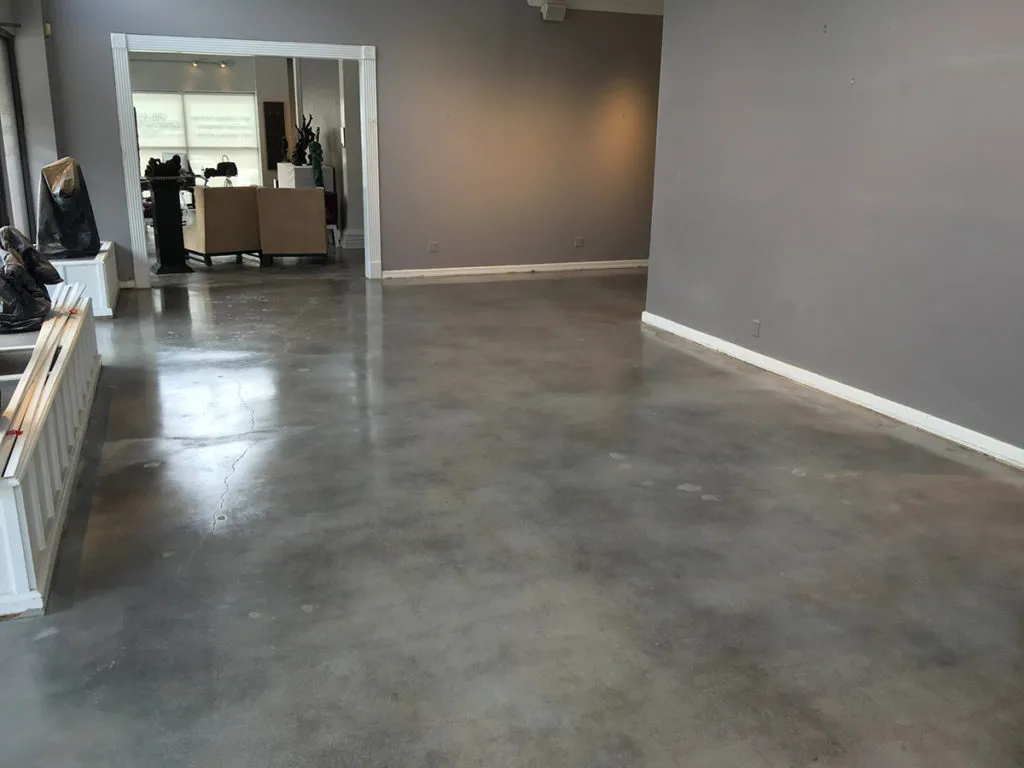
Why does my new concrete have dark and light patches?
Fresh concrete dries unevenly, so dark and light areas are common for the first few weeks. Shade from the house, a damp spot in the base and different truckloads all show as different colors. Much of it evens out over a couple of months. Blotches that stay often come from uneven troweling or curing compound put on unevenly.
What happens if it rains on fresh concrete?
If it rains on fresh concrete in the first few hours, the surface can be pitted or washed weak. After the surface has set, light rain does little harm and can even help curing. Rain is rare here from late spring to fall. In winter we watch the forecast and keep plastic on site.
There are footprints, rough spots and a wavy finish with low spots. Is that acceptable?
No. Footprints, trowel marks and birdbaths that hold water are finishing faults. A broom finish should be even, and a slab should drain without puddles deeper than a coin. Mark the low spots after hosing the slab down, take photos and ask the contractor how they will be corrected.
Are control joints really necessary?
Yes. Control joints are planned weak lines that tell the concrete where to crack as it shrinks. Without them the slab picks its own lines. On a 4-inch slab they are spaced about 8 to 12 feet apart and cut about a quarter of the slab depth.
The contractor says he will saw-cut the joints a week later. Is that all right?
No. A week is too late. Saw-cut joints need to go in as soon as the slab can take the saw without raveling, which in our summer heat is often the same afternoon or the next morning. By day seven the slab has usually cracked where it wanted to.
My slab was poured without rebar or mesh and I only found out afterward. What now?
First read the contract. If it promised steel and the slab was poured without rebar or mesh, that is a breach and you can ask for a remedy in writing. If it was silent, a 4-inch patio or walk on a firm, compacted base can perform acceptably unreinforced. A driveway, or any slab on fill or clay here, is at higher risk of cracks opening and panels shifting.
My new stamped concrete is slippery when wet. Can that be fixed?
Yes. Slippery stamped concrete is nearly always the sealer, not the concrete. A glossy film sealer on a smooth pattern is slick when wet. The usual fix is a fresh coat with a fine grip additive mixed in, or stripping to a lower-sheen sealer. Around a pool this should have been done from the start.
Why is my stamped concrete cloudy, faded or peeling?
A cloudy white haze means moisture is trapped under the sealer, often because it went on too thick or over a damp slab. Fading is the sun wearing the sealer and the surface color, which happens fast at this latitude. Peeling means the sealer never bonded. All three are fixed by stripping or re-emulsifying the sealer and reapplying thin coats.
The surface started flaking in the first year. We barely get a freeze. Why?
In most of this valley, flaking in the first year is not a winter problem at all. It comes from a surface that was overworked, had water sprinkled on it, or dried out in the first hours. In Acton, where the first freeze can come early, a slab poured late in fall without air-entrained concrete can scale from frost. Either way, raise it with the contractor promptly.
It was poured in extreme heat and now it looks bad. Was that the cause?
Quite possibly. Concrete poured in afternoon heat sets before the crew can finish it properly. Signs are crazing, a dusty weak surface, color differences and cracks between joints. Good practice here is to start at dawn, dampen the base, use a retarder if needed and cure immediately. Ask what time the truck arrived and what curing was done.
The crew left ruts in the lawn, washout slurry and splatter on the wall. Who cleans that up?
The contractor does. Ruts from buggies, cement washout dumped in a planter and splatter on stucco are site damage, and a tidy quote names cleanup as part of the job. Truck washout must not go down a street gutter or storm drain. Note it before final payment.
My new pad is out of level. How far off is too far?
Outdoor slabs are meant to slope a little, about an eighth to a quarter inch per foot, so water runs off. A pad for a shed, spa or equipment should be flat to what the maker requires. If your pad is out of level beyond that, a level and a tape measure will show it. Small errors can be ground or topped. Large ones mean a repour.
Call (661) 718-4706 if you want a second opinion on a slab someone else poured. We will tell you plainly what we see.